Fair Total Range
Most cars and trucks land between $300 and $900 total. In Phoenix, $500 to $700 is the most common range for everyday vehicles.
For most vehicles, a fair alternator replacement price is $300 to $900 for parts and labor, although vehicle design, amperage, and part choice can move the total. Phoenix Mobile Car Mechanic diagnoses and replaces alternators at homes, offices, and roadside locations across the Valley, with parts and labor quoted separately before work begins.
Most cars and trucks land between $300 and $900 total. In Phoenix, $500 to $700 is the most common range for everyday vehicles.
Part type and amperage matter, but access often changes labor most. A front-mounted alternator is usually simpler than one beneath the intake manifold or behind a motor mount.
Confirm that the quote itemizes diagnosis, parts, labor, and any core charge. Ask whether the unit is aftermarket, remanufactured, or OEM and what warranty applies.
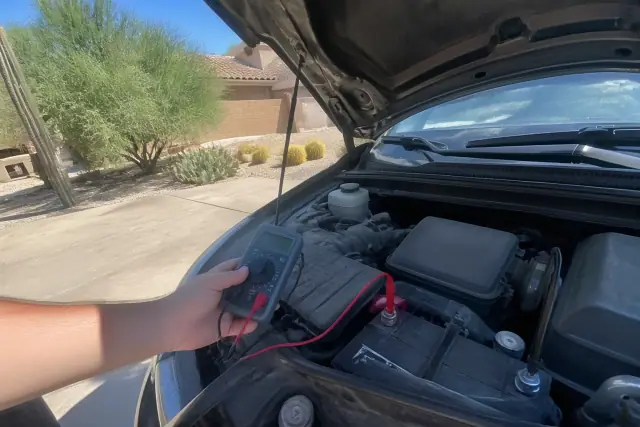
A meter checking output at idle and under load, typically 13.5 to 14.7 volts. This confirms whether the fault is the alternator rather than the battery or wiring.
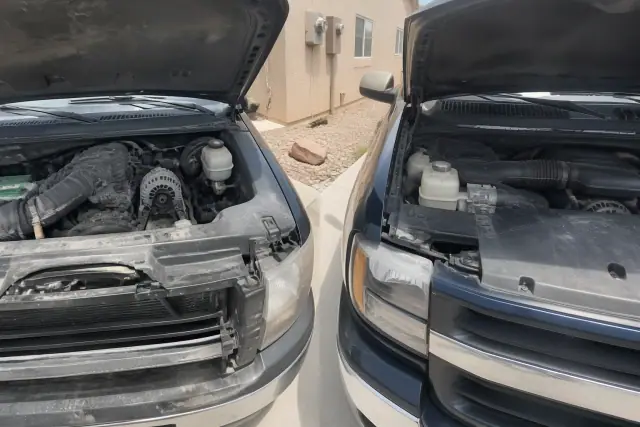
Compare a front-mounted alternator with one below an intake manifold or behind a motor mount. The visual makes the labor-time difference easy to understand.
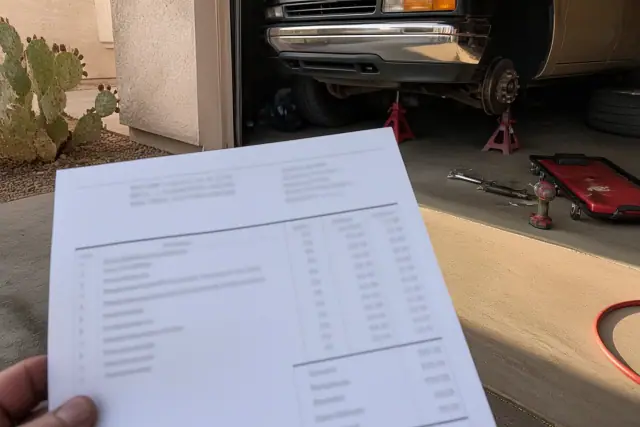
Parts, labor, and the core charge as separate line items. The part line should identify aftermarket, remanufactured, or OEM so the options can be compared fairly.
Phoenix metro pricing generally runs $350 to $850, with an average around $580. Everyday vehicles most often fall between $500 and $700, while broader industry data places the combined average between $747 and $842.
Parts usually cost $100 to $500, and labor adds roughly $150 to $350 for a typical 1 to 2 hour job. Phoenix independent and mobile labor commonly runs $100 to $160 an hour, compared with $180 to $220 an hour at many dealership service departments.
Hard-to-reach alternators, high-output units, trucks, diesels, and luxury imports can push the total toward $1,000 or more. A $1,400 quote for a standard sedan with normal access is outside the usual range and should clearly explain the added parts or labor.
A quality aftermarket alternator can cost 30% to 50% less than OEM. Returning the old unit can also avoid a $20 to $50 core charge.
| Alternator Replacement Scenario | Typical Parts Cost | Typical Total |
|---|---|---|
| Most cars and trucks | $100 to $500 | $300 to $900 |
| Simple four-cylinder access | Varies by unit | About $350 to $400 |
| Common Phoenix job | Included in total | $500 to $700 |
| Hard access or high output | Often higher | Toward $1,000 or more |
A fair quote starts with a battery and charging-system diagnostic to distinguish alternator failure from a battery, wiring, or grounding issue. Replacement includes serpentine-belt removal, wiring-harness disconnection, the alternator swap, belt re-tensioning, and mounting bolts torqued to manufacturer specification. A post-install test should verify output at idle and under load, typically 13.5 to 14.7 volts. Parts, labor, and any core charge should appear separately.
Price rises with part availability, amperage output, and anything that must be removed for access, such as an intake manifold, motor mount, or wheel-well liner. A high-output unit for heavy electrical loads costs more than a standard 90-amp alternator, while quality aftermarket units generally run 30% to 50% less than OEM. Summer temperatures inside a parked Phoenix vehicle can regularly exceed 150 degrees, and repeated heat cycling can accelerate bearing and voltage-regulator wear.
Most alternators last 7 to 10 years or 80,000 to 150,000 miles under normal conditions, although Phoenix heat and long traffic idling can shorten that window. Replacement usually takes 1 to 2 hours, with extra time for hidden mounting positions. Dimming headlights, a battery warning light, or a whining noise are reasons to test the charging system before approving replacement. To control cost, compare an itemized quote and ask about a quality aftermarket option with a clear warranty.
Share your vehicle details and symptoms to arrange an on-site charging-system diagnosis at your home, office, or roadside location across the Valley. The estimate can separate the alternator, labor, and any core charge before work begins.