Proudly serving Phoenix, Glendale, Scottsdale, Tempe, Mesa, Chandler & surrounding areasCall or Text 24/7: 480-210-2603

Mobile AC Repair, Leak Inspection & Refrigerant Recharge in Phoenix, AZ

Phoenix Mobile Car Mechanic brings AC repair and refrigerant recharge to parked vehicles across Phoenix, AZ. Our mobile service also covers check engine light diagnostics, brake repair, and car battery replacement. We handle alternator and starter replacement, oil changes, radiator and cooling system repair, spark plug and ignition coil replacement, and pre-purchase car inspections. We work at homes, offices, driveways, and parking lots so drivers can skip the shop drop-off.

Phoenix pavement can reach 150-plus degrees in July, while a parked cabin can climb well past 140 degrees within minutes. That makes warm vent air a safety concern as well as a comfort problem. Technicians arrive with manifold gauges, electronic leak detectors, refrigerant identifiers, recovery equipment, and vacuum pumps. We pressure-test for the cause, verify the factory-specified refrigerant, and explain pricing before work begins.

Phoenix spans 517.9 square miles and has over 1.6 million residents within a metro of roughly 5.19 million people, so bringing service to the vehicle can eliminate a long hot drive and a shop wait.

Phoenix Mobile Car Mechanic provides mobile AC repair and recharge throughout Phoenix, Scottsdale, Tempe, Mesa, Glendale, and the greater Maricopa County metro area.

★ ★ ★ ★ ★4.9/5 Average Rating · 20+ Years of Experience · Thousands of Customers Helped · Licensed & Insured · Residential & Commercial

Mobile AC Service Options & Benefits

What Does Mobile Car AC Service Include?

Automotive AC is a closed loop in which the compressor pressurizes refrigerant, the condenser turns it into liquid, an expansion valve or orifice tube meters the flow, and the evaporator absorbs cabin heat. Correct charge and oil lubrication are essential to every part of that cycle.

Mobile service brings the recovery station and diagnostic tools to a driveway, office parking lot, or another place where the vehicle is parked. The visit can include pressure readings, vent-temperature checks, compressor-clutch testing, leak detection, evacuation, repair, and recharge.

The technician checks the underhood label before opening the system because R-134a and R-1234yf require the correct fittings, refrigerant, and oil. Adding the wrong material or changing the charge without diagnosis can damage seals and the compressor.

Benefits of Diagnostic-First AC Service

Average July highs around 104 to 107 degrees put sustained demand on a vehicle's cooling system. A diagnostic-first visit targets the reason cooling dropped instead of treating every problem as a simple top-off.

  • Service at your driveway, office, or parked location
  • High- and low-side pressure readings before recharge
  • Leak checks at hoses, fittings, seals, and components
  • Factory-specified refrigerant and lubricant selection
  • Vent-temperature and compressor-clutch performance checks
  • Transparent pricing after the system is evaluated
  • Service for cars, trucks, and SUVs
  • No vehicle drop-off, rideshare home, or waiting room
Automotive Air Conditioning

Mobile AC Repair & Recharge Services

Warm air can come from low refrigerant, restricted airflow, a leak, an electrical or clutch problem, a damaged heat exchanger, or internal compressor failure. These services separate the symptom from the cause and match the repair to the system's condition.

AC Diagnostics and Pressure Testing

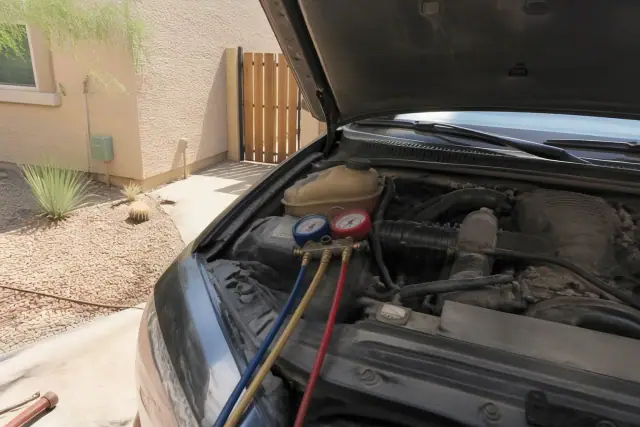
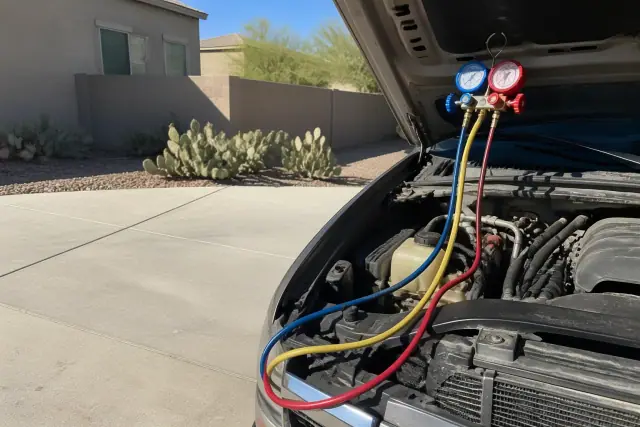
Manifold gauges connected to a vehicle's AC system during diagnostic testing at a residence in Phoenix, AZ.

A manifold gauge set compares high- and low-side pressures with ambient-temperature charts. Vent temperature, clutch engagement, belt and pulley condition, hoses, fittings, and the condenser face are also checked before a recharge is recommended.

Request Estimate

Refrigerant Recovery and Recharge

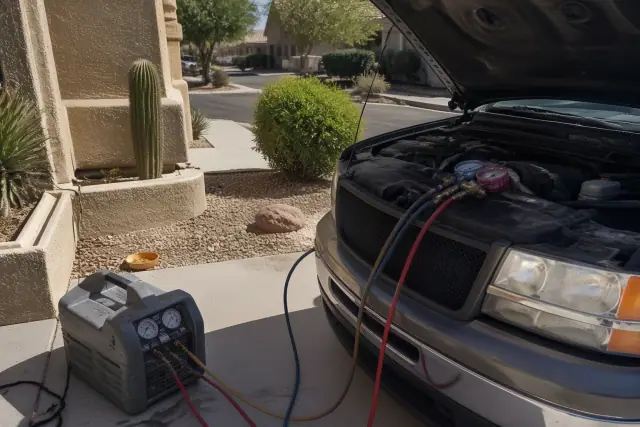
Technician recovering refrigerant from a car AC system on a residential property in Phoenix, AZ.

Existing refrigerant is recovered, the system is evacuated, and the specified charge is restored with R-134a or R-1234yf as required by the vehicle. Correct PAG or POE oil is added in the quantity specified for the compressor when a full evacuation and recharge calls for it.

Request Estimate

Refrigerant Leak Detection and Repair

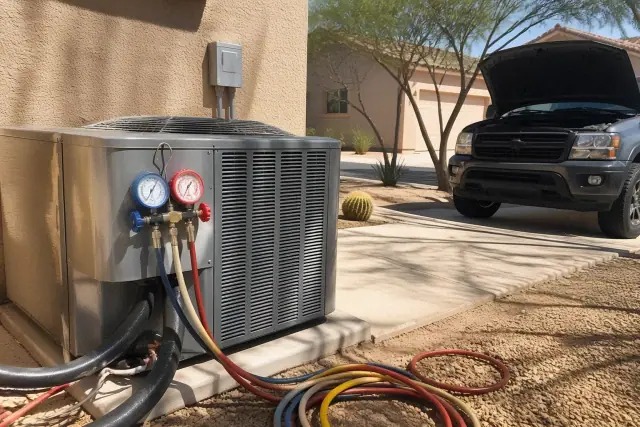
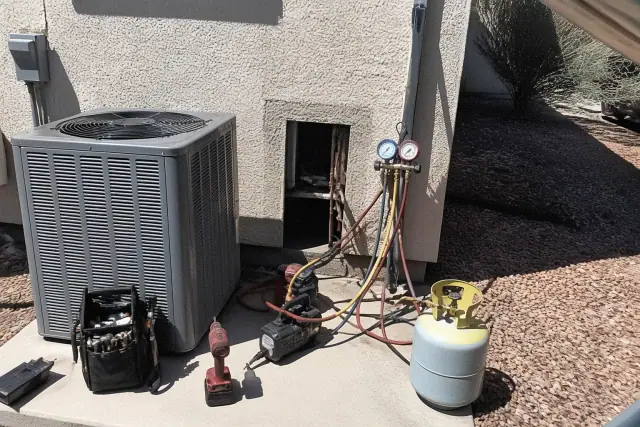
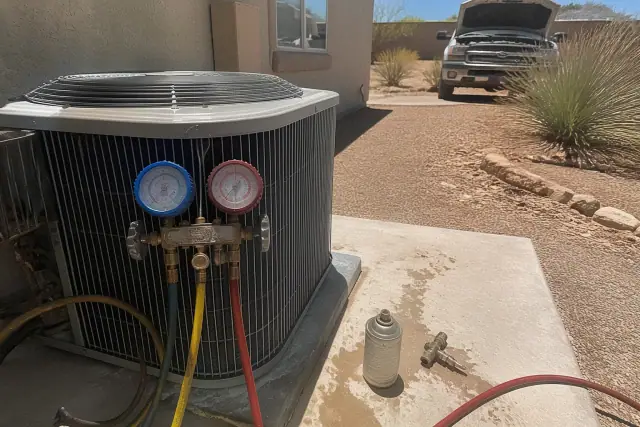
Manifold gauges attached to an HVAC condenser unit during a refrigerant repair at a home in Phoenix, AZ.

UV dye and electronic sniffer detectors can reveal leaks as small as a fraction of an ounce per year. A controlled nitrogen pressure hold can isolate leaks that do not appear at normal operating pressure, after which an O-ring, hose, shaft seal, or drier may be repaired or replaced.

Request Estimate

AC Compressor Repair and Replacement

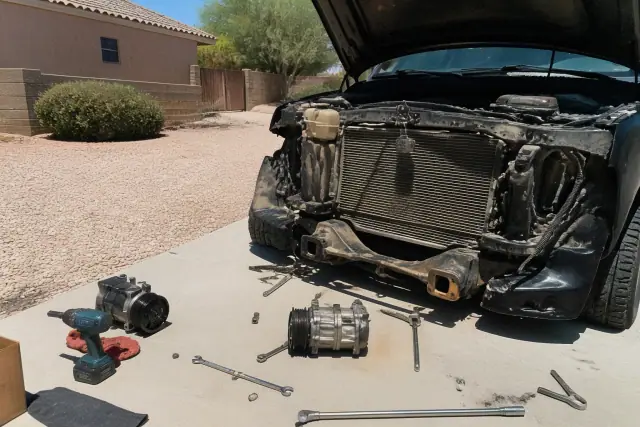
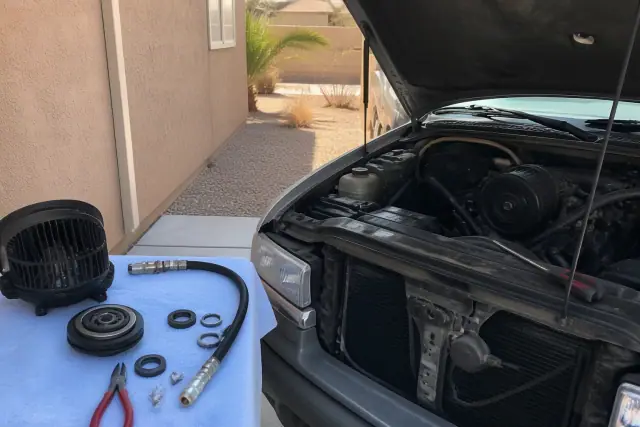
AC compressor repair on a vehicle parked on a concrete pad at a residential home in Phoenix, AZ.

A failed clutch, shaft seal, or single hose may allow a targeted repair, while internal bearing failure or metal in the lines calls for compressor replacement and a system flush. Depending on the vehicle and contamination, compressor parts and labor can range from several hundred dollars into the low thousands.

Request Estimate

Condenser and Evaporator Service

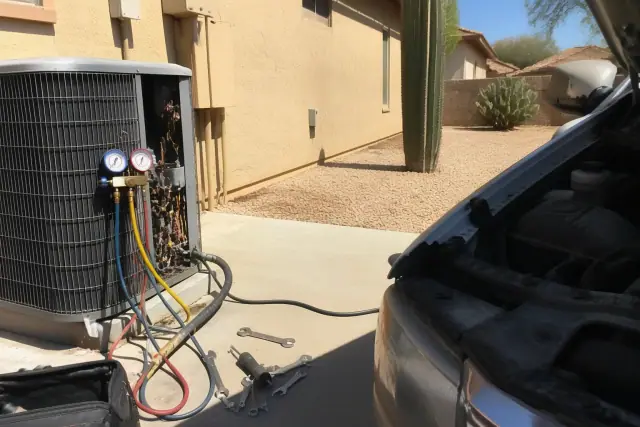
AC repair service with gauges and hoses connected to a residential unit on a concrete pad in Phoenix, AZ.

Dust and debris can clog condenser fins and reduce heat release, while an evaporator leak behind the dash causes continuing refrigerant loss. The condenser can be cleaned or replaced when damaged, and evaporator problems are evaluated before another recharge is added.

Request Estimate

Blower, Clutch, Hose, and Seal Repairs

Vehicle AC repairs including blower, clutch, hose, and seal work in progress at a residential home in Phoenix, AZ.

A blower motor or resistor can limit cabin airflow even when the refrigerant charge is correct. Intermittent cooling may instead trace to a worn clutch coil or bearing, while Arizona UV exposure and underhood heat can harden hoses and O-rings at their fittings.

Request Estimate
System-Specific Repairs

Automotive AC Service Options

The right service depends on the refrigerant named on the underhood label, the pressure pattern, the location of any leak, and whether debris or moisture entered the loop. These options cover the materials and components most often involved in a complete diagnosis.

A vehicle undergoing R-134a refrigerant service with pressure gauges on a concrete pad in Phoenix, AZ.

R-134a Refrigerant Service

R-134a systems need compatible recovery equipment, fittings, oil, seals, and a charge matched to the vehicle specification. The label and system condition are checked before refrigerant is removed or added.

  • Underhood refrigerant-label verification
  • R-134a-compatible service fittings
  • Recovery before evacuation and recharge
  • Oil type and quantity matched to the compressor
  • Pressure and vent-temperature verification
Request Estimate
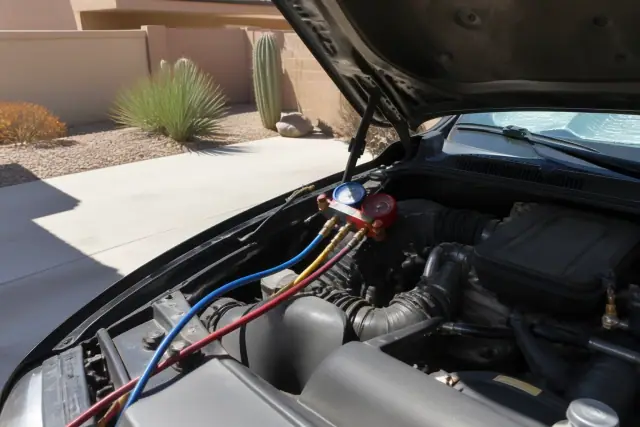
Technician performing an R-1234yf AC recharge on a vehicle engine bay at a residence in Phoenix, AZ.

R-1234yf Refrigerant Service

R-1234yf is a lower-global-warming-potential refrigerant found in many newer vehicles. Its dedicated fittings and material requirements make refrigerant identification and the factory charge specification especially important.

  • Refrigerant identification before recovery
  • R-1234yf-specific fittings and equipment
  • Vehicle-specified refrigerant quantity
  • Compatible oil and seal materials
  • Final pressure and cooling-performance check
Request Estimate
Technician checking vehicle AC refrigerant levels with gauges on a concrete pad at a residential home in Phoenix, AZ.

Leak and Seal Repair Options

Low charge means refrigerant escaped from the sealed loop. Finding the source first helps determine whether the system needs a small seal repair, a hose assembly, or a larger component replacement.

  • UV dye tracing at suspected leak points
  • Electronic detector inspection
  • Controlled nitrogen pressure hold
  • Correct nitrile or HNBR O-ring replacement
  • Hose crimp and compressor shaft-seal evaluation
Request Estimate
Technician repairing an HVAC unit on a concrete driveway in Phoenix, AZ, with tools and gauges on the ground.

Major HVAC Component Repairs

Some failures require more than refrigerant service. Component testing distinguishes a damaged heat exchanger, airflow problem, metering fault, or compressor problem before parts are selected.

  • Compressor and clutch repair or replacement
  • Condenser cleaning or replacement
  • Evaporator core leak repair
  • Blower motor and resistor testing
  • Expansion valve function testing
Request Estimate
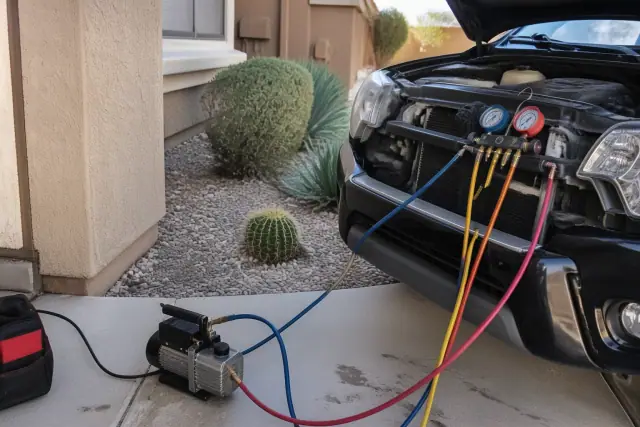
AC vacuum pump and gauge manifold connected to a vehicle for air conditioning repair in a Phoenix, AZ driveway.

Moisture and Contamination Control

Moisture can form acid inside the loop, and metal from a failed compressor can circulate through repaired components. Recovery, evacuation, flushing when needed, and drier replacement help keep those contaminants out of a restored system.

  • Recover the existing refrigerant charge
  • Flush metal debris after internal compressor failure
  • Replace a saturated receiver drier after major opening
  • Pull at least 29 inches of vacuum and hold it
  • Restore the specified refrigerant and compressor oil
Request Estimate
Repair the Cause

Choosing the Right AC Service Approach

The pressure pattern, leak location, compressor condition, refrigerant type, and required quantity determine whether a recharge, targeted repair, or major replacement makes sense. Finding an evaporator or hose leak during a $250 to $350 diagnostic-and-recharge visit can avoid waiting for a starved compressor to seize and turn the job into an $800 to $2,500 replacement.

Mobile Service at Your Vehicle

Recovery machines, vacuum pumps, gauges, and refrigerant fittings come to homes, offices, and driveways, including locations near I-10 and Loop 101. During peak summer, appointments are scheduled quickly because a driver without cooling should not have to plan around a two-week shop opening.

Standards-Based Refrigerant Handling

Recovery and recharge follow SAE J2788 procedures and EPA Section 609 refrigerant-handling requirements. Refrigerant identifiers and vehicle labels keep R-134a and R-1234yf materials separated and matched to the system.

Diagnosis and Pricing Before Work

The system is pressure-tested and checked for leaks instead of being topped off automatically. Results and pricing are explained before repair begins, and seasonal service with an annual reliability check can expose small leaks before the charge is lost.

What Sets the Service Apart

Why Choose Mobile AC Service in Phoenix?

Phoenix Mobile Car Mechanic combines on-site convenience with the same diagnostic sequence expected before a proper recharge: identify the refrigerant, inspect the loop, read pressures, find leaks, and confirm performance. You receive the recommended repair and price before the system is opened for work.

Request AC Diagnosis

Warm or Lukewarm Vent Air

Air that cooled last summer but now feels lukewarm can point to a slow loss of charge. Rapid compressor-clutch cycling can appear with the same undercharged condition, so pressures and leaks need to be checked together.

Weak or Intermittent Airflow

Weak airflow can come from a clogged cabin filter, a blower motor, or its resistor rather than low refrigerant. Cooling that works at highway speed but fades at idle can also indicate low charge or a clutch problem.

Refrigerant Leaks

Oily residue near a hose fitting can mark a seepage point because refrigerant carries compressor oil through the loop. Recharging without sealing the source may restore cooling for only a few weeks before the charge falls again.

Pressure or Vacuum Failure

Low readings on both sides can indicate undercharge or a leak, while abnormal high-side pressure can point to a restriction, overcharge, or contamination. A system that will not hold vacuum has an active opening that should be located before recharge.

Compressor Noise or Seizure

Grinding or squealing when the AC engages, a clutch that stays engaged, metal in recovered refrigerant, or a physically seized compressor can indicate internal failure. Metal contamination changes the job from a targeted repair to replacement and a system flush.

Dust and Heat Damage

Phoenix dust can pack condenser fins and restrict the airflow needed to reject heat. Prolonged Arizona UV exposure and underhood heat also age barrier hoses and harden O-rings, increasing the chance of seepage at crimps and connections.

How It Works

Our Mobile AC Service Process

The visit moves from symptom review and refrigerant identification to pressure testing, leak detection, a clear repair recommendation, and final performance verification. On-site diagnosis, recovery, evacuation, and recharge are often completed in under two hours, depending on the repair needed.

01.

Review the Symptoms

We note whether the air is always warm or only warm at idle, whether the clutch clicks, and whether there is unusual noise, odor, or oily residue. The vehicle's parked location and operating symptoms guide the first inspection.

02.

Identify the Refrigerant

The underhood label and a refrigerant identifier confirm the vehicle specification before a recovery tank is connected. This keeps the service equipment, fittings, oil, and charge appropriate for the system.

03.

Inspect and Test Performance

High- and low-side pressures are compared with ambient conditions while vent temperature, clutch engagement, belt and pulley operation, blower speed, hoses, fittings, and condenser condition are checked. These readings distinguish charge problems from airflow or component faults.

04.

Locate Leaks and Explain Pricing

Visual inspection, dye tracing, electronic detection, vacuum behavior, or a nitrogen hold can identify where refrigerant is escaping. The recommended repair and price are explained before work begins.

05.

Recover, Evacuate, and Repair

Old refrigerant is recovered before the system is opened or evacuated. Approved work may include an O-ring, hose, drier, valve, clutch, compressor, condenser, evaporator, or blower repair based on the diagnosed fault.

06.

Recharge and Verify Cooling

The system receives the specified refrigerant and required compressor oil after it holds evacuation. Final pressure, vent-temperature, clutch, and airflow checks confirm how the repaired AC performs before the service is complete.

Get Cool Air Back

Schedule Mobile
AC Service in
Phoenix

Tell us where the vehicle is parked and what the vents, blower, and compressor are doing. Phoenix Mobile Car Mechanic can bring AC diagnostics, leak detection, repair equipment, and refrigerant service to your location.

Phoenix Car AC Help

AC Repair & Recharge FAQs

These answers cover Phoenix recharge pricing, leak diagnosis, refrigerant types, compressor concerns, and what to expect from mobile AC service.

Call About Car AC

Phoenix-market recharge service typically runs from $150 to $500, and many straightforward R-134a recharges fall in the $150 to $300 range. Refrigerant type, required quantity, and leak, O-ring, hose, or drier work can change the total. Offers well under $100 may omit a pressure test or leak check, so confirm what the price includes.

It may restore cooling for days or weeks, but low refrigerant usually means the sealed system has a leak. A pressure test and dye check show whether a recharge can hold or whether an O-ring, hose, drier, or other component should be repaired first. Recharging without fixing the leak can lead to paying for the same service again.

The 3-minute rule means waiting roughly three minutes after shutting off the AC compressor before restarting it. The pause lets internal pressures equalize and reduces strain on the clutch and belt. It matters more with older or aftermarket controls because many modern factory systems have built-in delay protection.

Yes, in many full evacuation-and-recharge situations. Refrigerant carries PAG or POE oil that lubricates the compressor, and some oil leaves with leaked or recovered refrigerant. The oil type and quantity must match the compressor because an incorrect lubricant can damage seals and shorten compressor life.

Note whether the air is always warm or only warm at idle, whether the compressor clutch clicks, and whether you hear or smell anything unusual. Check the cabin air filter because restricted airflow can imitate an AC failure. A photo of oily residue near a hose or fitting may also help narrow the first inspection.

Ambient temperatures above 100 degrees for months at a time increase thermal stress on hoses, O-rings, and the condenser. High-side pressures also rise in extreme heat, so marginal components and small leaks may show symptoms sooner than they would in a milder climate. That is why a preventive pressure check can be useful even while the system still cools.

Vehicles built after the mid-1990s generally use R-134a, while newer models since roughly 2015 increasingly use lower-global-warming-potential R-1234yf. The refrigerants require the correct fittings, oil, seals, and charge, so the underhood label is verified before service. Mixing them can damage components and reduce designed cooling capacity.

The process can combine a visual inspection, UV dye tracing, an electronic sniffer, and a controlled nitrogen pressure hold. Each method helps isolate leaks at hose crimps, compressor shaft seals, O-rings, the receiver drier, or less-visible components. The chosen repair depends on the confirmed source.

A vacuum that will not hold indicates an active opening in the sealed refrigerant loop. Common locations include hose crimps, the compressor shaft seal, O-rings, and the receiver drier. The leak should be located and addressed before refrigerant is added.

Grinding or squealing at engagement, a clutch that will not disengage, metal in recovered refrigerant, or a seized compressor can indicate internal failure. A clutch, shaft seal, or isolated hose problem may still allow a targeted repair. Internal bearing damage or metal contamination generally requires replacement plus a system flush.

Timing depends on whether the vehicle needs diagnosis and recharge or a component repair. Recovery, evacuation, leak confirmation, access to failed parts, and the final performance test all affect the appointment. The technician can give a clearer expectation after the system is inspected.

That pattern can point to low refrigerant, a weak compressor clutch, reduced condenser airflow, or another performance fault. Pressure readings at the current ambient temperature help separate an undercharge from a restriction or component problem. A recharge should follow diagnosis rather than replace it.

The receiver drier should be replaced when the system is opened for a major repair. It removes moisture and filters debris, but a saturated drier can return moisture to the loop. That moisture can form acid and corrode internal components.