Typical Recharge Range
A leak-free R-134a recharge usually falls between $150 and $300. That service should include a pressure check, refrigerant recovery, a vacuum cycle, and a charge measured to the vehicle's specified weight.
Phoenix Mobile Car Mechanic typically sees a straightforward R-134a recharge in Phoenix cost $150 to $300, while newer R-1234yf systems or leak repairs cost more. When Valley temperatures climb past 110°F for weeks, dependable cooling matters on I-10, Loop 202, and local streets. The final price depends on refrigerant type, system capacity, pressure readings, and whether a leak must be fixed first.
A leak-free R-134a recharge usually falls between $150 and $300. That service should include a pressure check, refrigerant recovery, a vacuum cycle, and a charge measured to the vehicle's specified weight.
R-1234yf costs several times more per pound than R-134a, and a leaking O-ring, Schrader valve, or hose fitting adds parts and labor. Compressor condition, cabin filter blockage, and how long the system sat empty also affect the scope.
Static and running pressure readings, compressor-clutch operation, and signs of refrigerant oil help determine whether the vehicle needs only a recharge or a repair. The system is then recovered, vacuumed to remove air and moisture, and recharged to the amount on the underhood A/C label.
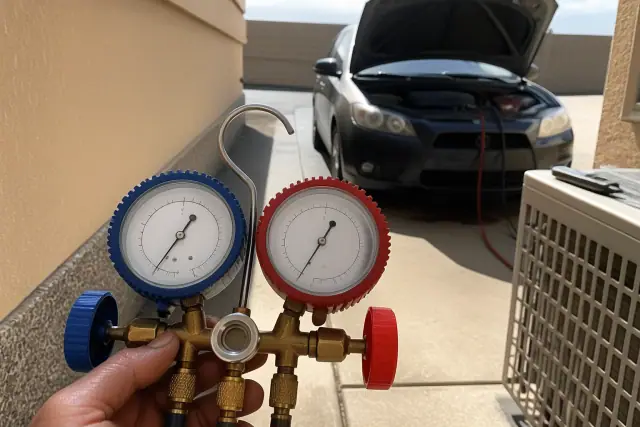
Static and running readings on manifold gauges help separate a low refrigerant charge from another cooling-system fault.
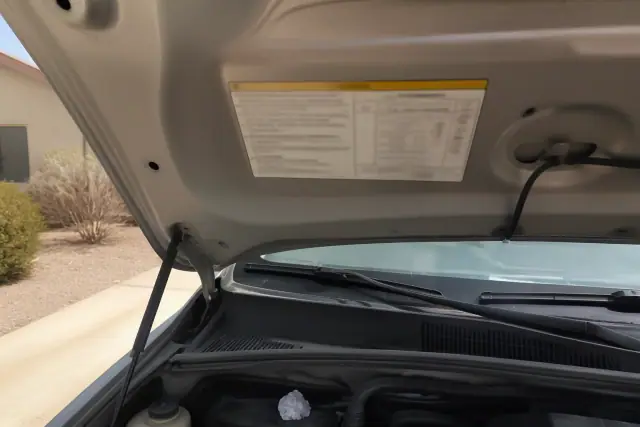
The vehicle's underhood A/C label identifies its refrigerant type and specified charge amount. Correct service weighs refrigerant to that specification instead of guessing from a single pressure gauge.
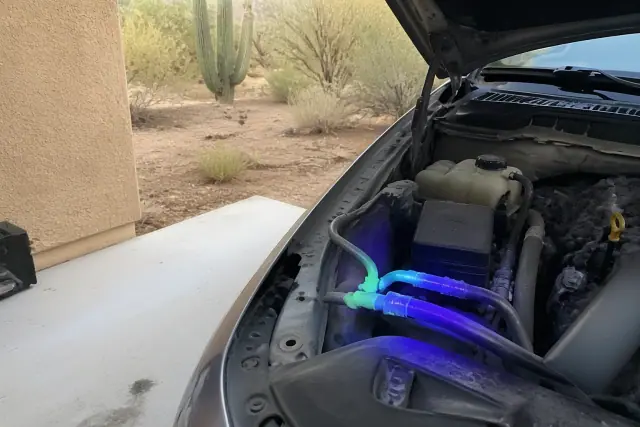
Dye or oil residue around O-rings, valves, and hose fittings helps locate a refrigerant leak. Finding the leak first prevents a fresh charge from escaping again within a week.
$150-$250 is the lower, all-in portion of the stated range for a straightforward R-134a system with no leak history.
$250-$400 is a typical range for R-1234yf vehicles because the refrigerant itself costs more per pound.
$250-$450 is the stated range when leak detection and a small repair are part of the appointment; leak work alone can add $50-$150.
Plan on 45-75 minutes total. The recharge itself takes about 20-30 minutes after the gauges are connected, with the remaining time used for the leak check and vacuum cycle.
| Service situation | Typical range | What changes the decision |
|---|---|---|
| Straightforward R-134a recharge | $150-$300 | No leak is found during the pressure check. |
| R-1234yf recharge | $250-$400 | The newer refrigerant costs more per pound. |
| Recharge with leak work | $250-$450 | Dye testing, an O-ring, or a hose fitting is added. |
| DIY top-off kit | $40-$130 | The kit does not test for leaks, pull a vacuum, or verify the exact charge weight. |
| Compressor replacement | $500-$1,200 or more | This is a separate repair, not a basic recharge. |
A proper recharge recovers the old refrigerant, pulls a deep vacuum to remove moisture and air, and weighs in the new charge to the exact amount on the underhood label. Moisture left behind can corrode the compressor or clog the orifice tube, while overcharging or undercharging by even a few ounces can reduce cooling and damage the compressor. For context, professional recharge comparisons span $239-$350, while broader full-service AC work in Arizona averages near $310 with a common $207-$517 range. A 2024 regional comparison placed standard recharges in a $150-$350 window, while a national comparison placed full AC repair with parts at $384-$445; those broader figures should not be mistaken for the price of a simple recharge.
Refrigerant accounts for roughly $80-$150 of the total, and recovery, vacuum, and recharge labor generally runs $100-$180 before parts. Cost increases when R-1234yf is required or when UV dye or an electronic sniffer finds a leak at an O-ring, valve, hose, condenser, or compressor. A vent temperature of 50-60°F instead of the expected 38-45°F can indicate a low charge, but weak airflow, clutch problems, or a blocked cabin filter may point elsewhere. Compressor replacement is a different repair and can run $500-$1,200 or more.
How often should car AC be recharged? A sealed system has no set recharge schedule because refrigerant is not used up; needing service annually points to a slow leak. Can a $40-$130 DIY kit handle it? A kit may top off a mildly low system, but its single gauge cannot recover refrigerant, remove moisture, test for leaks, or verify charge weight. Recharge makes sense when the system holds a charge for more than a season; pressure loss again within weeks suggests a condenser, compressor, hose, or seal repair instead. A well-maintained compressor, condenser, and evaporator can last 10-15 years or more, and a leak-free system may hold its charge for a decade or longer.
Share the vehicle's year, make, model, location, and cooling symptoms to confirm its refrigerant type and a price range before service. Mobile appointments are available at homes, offices, and parked vehicles across Phoenix, Scottsdale, Tempe, Mesa, Gilbert, and Chandler. Ask about same-day, next-day, Saturday, Sunday, or emergency availability when driving without working AC is unsafe or impractical.