Rising Gauge Means Stop
A temperature needle moving above its normal range, fluctuating between normal and hot, or triggering a dash warning shows that the engine is no longer maintaining stable operating temperature.
Phoenix Mobile Car Mechanic diagnoses and repairs cooling systems at driveways, offices, and parking lots across the Salt River Valley. A rising temperature gauge, coolant leak, steam, a sweet or burning odor, or unstable cabin heat can mean the system is no longer controlling engine temperature, so confirming the cause before driving farther can help prevent engine damage.
A temperature needle moving above its normal range, fluctuating between normal and hot, or triggering a dash warning shows that the engine is no longer maintaining stable operating temperature.
Coolant puddles, a reservoir that empties within days, sweet-smelling steam, or hissing after shutdown can trace the problem to a hose, radiator seam, water pump, heater core, or radiator cap.
A visual coolant inspection followed by hydrometer and pressure testing can confirm a failing system in under 30 minutes at the vehicle's location, while thermostat, block, and compression checks narrow down hidden circulation or gasket problems.
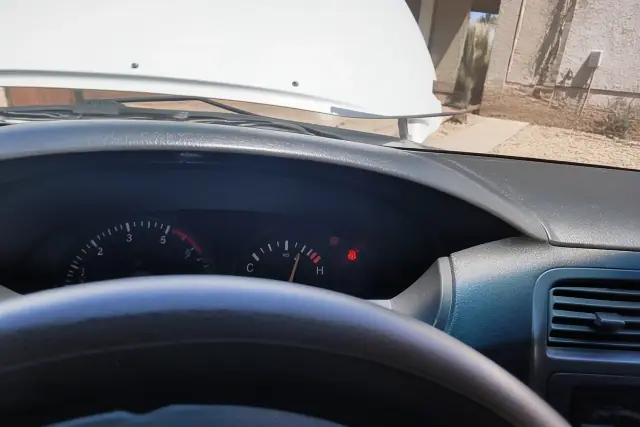
The temperature needle above its normal midpoint beside an illuminated warning light. This is the clearest cue to stop driving and let the engine cool.
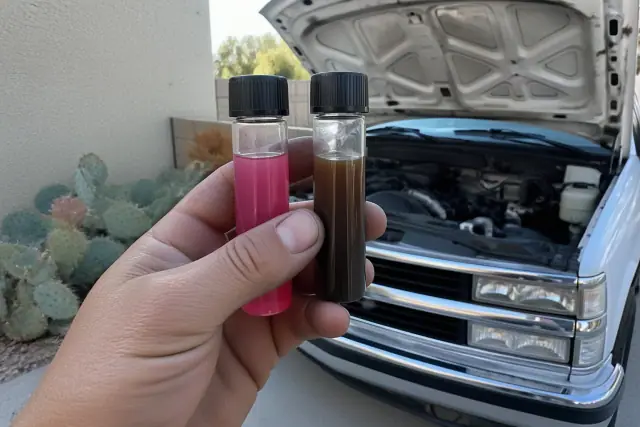
Clear, bright green, orange, or pink coolant beside dark, muddy, cloudy, or oily fluid. Color and debris help separate normal coolant from corrosion or contamination.
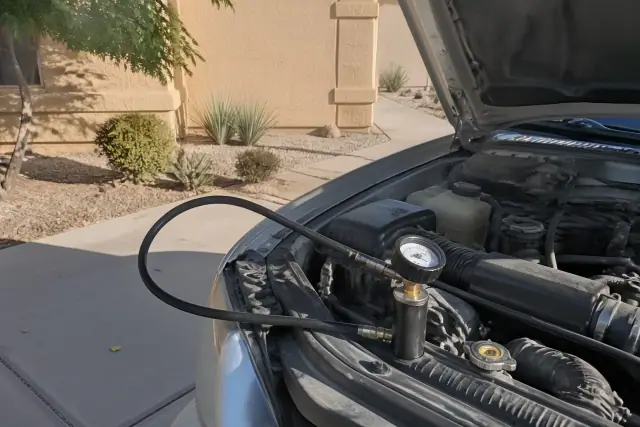
A portable cooling system test kit attached at the radiator cap opening. The gauge reveals slow leaks that may not appear during a cold visual inspection.
Note whether the gauge rises at idle, in traffic, or at highway speed, then let the engine cool and compare the reservoir level with the manufacturer's cold-fill line.
Thermostat replacement typically runs $150-$300 including labor. In Phoenix, radiator repair generally runs $300-$800, while radiator replacement often costs $500-$1,200 with labor.
Steam under the hood, a warning light, or a gauge climbing above normal calls for an immediate stop and cooldown; continuing can turn coolant loss into head-gasket or engine-block damage.
Repeatedly topping off low coolant is not a repair, and mixing incompatible coolant types can break down corrosion protection. Diagnose the leak or circulation problem before relying on a refill or flush.
| What You Notice | What It Can Mean | Recommended Action |
|---|---|---|
| Gauge above normal or warning light | Overheating or poor coolant circulation | Stop driving and let the engine cool |
| Colored puddle, steam, or sweet odor | Leak at a hose, radiator, water pump, or heater core | Use visual and pressure testing to trace it |
| Dark, rusty, cloudy, or oily coolant | Corrosion, mixed coolant, or possible gasket contamination | Check coolant strength and diagnose before flushing |
| Hissing, gurgling, or weak cabin heat | Pressure loss, trapped air, low coolant, or thermostat trouble | Test the cap, circulation, and thermostat |
An upward or fluctuating gauge means coolant is no longer absorbing and releasing heat consistently. Low coolant, a clogged radiator, a failed cooling fan, a stuck thermostat, or a failing water pump can each create that result, while white exhaust with a sweet smell may indicate coolant entering the combustion chamber. Catching an early warning before a full breakdown can mean a $100-$300 repair instead of a $1,500 engine repair.
Phoenix driving conditions can change what a symptom suggests: upward creep in stop-and-go traffic on Camelback Road or Interstate 10 may point to fan, thermostat, or trapped-air trouble, while a steady rise on Interstate 17 against 110°F ambient heat can indicate restricted radiator flow or a struggling cooling fan. A pressure tester is pumped to the rating printed on the radiator cap, typically 13-16 psi on modern vehicles, and held for 20-30 minutes. If pressure falls without a visible leak, a block test and compression check can investigate a possible head-gasket problem before teardown.
How often should coolant be changed? Silicate-based coolant is due around every 30,000 miles or two years, while extended-drain synthetic coolant can last up to 100,000 miles or five years when compatible with the vehicle. What might service cost? A simple hose swap may cost under $100, hose or leak repairs can run $100-$500, and a flush and refill is generally $100-$250. Broader cooling-system repair commonly falls between $300 and $1,000, while complete replacement may reach $700-$2,500 depending on the vehicle and extent of damage. Weak heater output or gurgling usually points back to low coolant, trapped air, or a thermostat problem.
Describe the gauge behavior, leak, odor, sound, or coolant condition and where the vehicle is parked. Phoenix Mobile Car Mechanic can inspect the cooling system at driveways, offices, and parking lots across the Salt River Valley and provide an upfront estimate before repair.